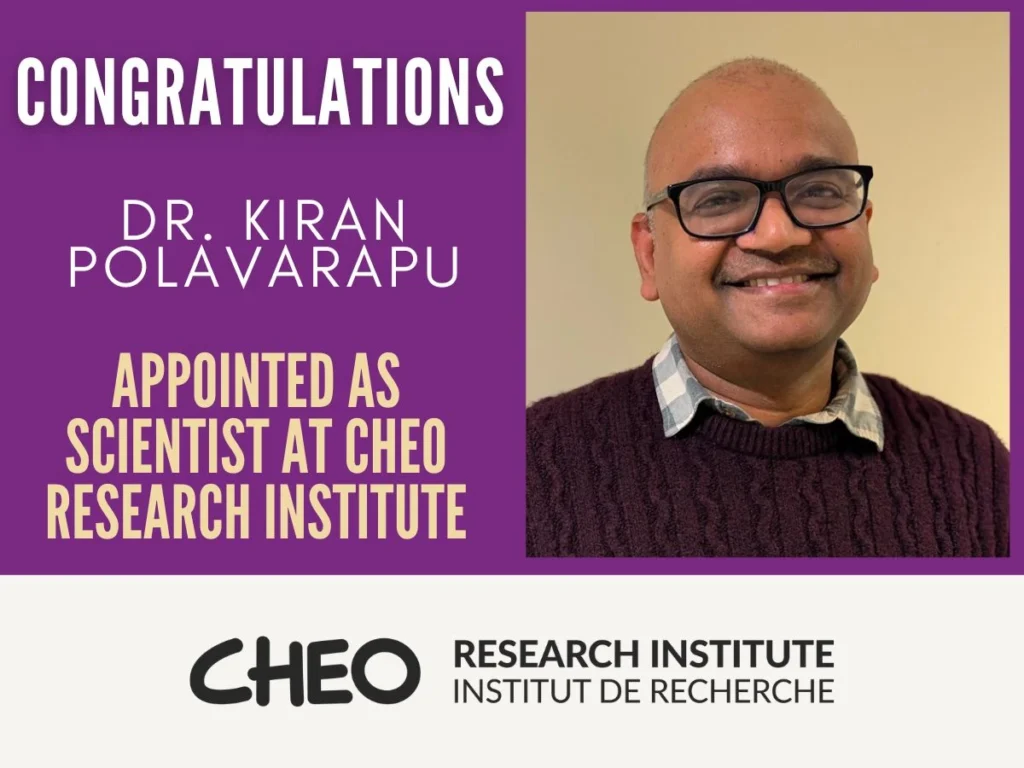
Dr. Kiran Polavarapu Appointed Scientist at the CHEO Research Institute
We are delighted to congratulate Dr. Kiran Polavarapu on his appointment as Scientist at the Children’s Hospital of Eastern Ontario Research Institute (CHEO RI). This marks Kiran’s first independent academic position following five highly productive years as a postdoctoral fellow in the Lochmüller Lab and gives him the opportunity to set up his own research group while still collaborating closely with the Lochmüller team.
Kiran’s research goal in his new position is to transform the diagnosis and understanding of rare and complex neuromuscular diseases (NMDs) through the application of advanced genomic and clinical bioinformatic approaches. With both a PhD in neuroscience and a residency in neurology at the National Institute of Mental Health and Neurosciences (NIMHANS), India, Kiran’s dual clinical and genomic training enables him to combine phenotypic expertise with a deep understanding of variant effects. A central focus of his research has been the characterization of large patient cohorts with these rare conditions, including DMD, congenital myasthenic syndromes (CMS) , limb girdle muscular dystrophies (LGMD), congenital muscular dystrophies (CMD) and congenital myopathies (CM) along with the identification of founder mutations especially in underrepresented populations from India.
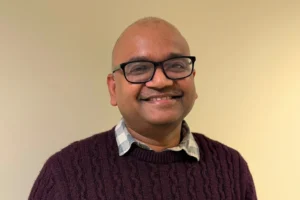
Dr. Kiran Polavarapu
During his postdoctoral training at CHEO RI, supported by a Canadian Institutes of Health Research (CIHR) Postdoctoral Fellowship, Kiran led the Lochmüller Dry Lab team: a group of clinicians, fellows, and students working on genomic analysis and variant interpretation to identify the genetic basis of previously unsolved rare neuromuscular diseases. Kiran’s research in the Lochmüller Lab contributed to the discovery of multiple novel disease–gene associations in neuromuscular disorders (TEFM , ATP2A2, LEMD2). His work has also provided new insights into pathogenic mechanisms, such as non-canonical splice site variants causing leaky splicing defects leading to novel phenotype associations.
Kiran has been involved in a number of exciting international collaborations during his time with the Lochmüller Lab. Through Solve-RD, a pan-European initiative aimed at diagnosing unsolved rare diseases, Kiran co-led the reanalysis and variant interpretation of a multinational cohort of more than 1,500 families affected by unsolved neuromuscular diseases, resulting in a diagnostic resolution rate of 9.1%.
In his new role as Scientist at CHEO RI, Kiran will continue to advance genomic diagnostics for rare NMDs, with a goal of improving diagnostic outcomes for all unsolved patients. The Lochmüller Lab warmly congratulates Kiran on this well-deserved appointment and looks forward to continued collaboration during the next phase of his research career!
Contact Kiran at to discuss collaboration opportunities or see polavarapulab.org (coming soon!)
Read next...

PhD completion – Congratulations!
New Publications Alert!
Meet The Lochmüller group’s Newest Members!