New Publication: Gene-specific response to muscle specific kinase agonist antibody in the treatment of congenital myasthenic syndromes
Congenital myasthenic syndromes (CMS) are a group of rare inherited neuromuscular disorders. Although many forms of CMS appear similar clinically, the disease can be caused by mutations in more than 40 different genes — making accurate genetic diagnosis essential for guiding treatment decisions.
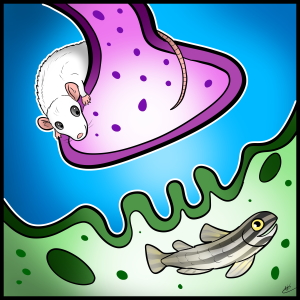
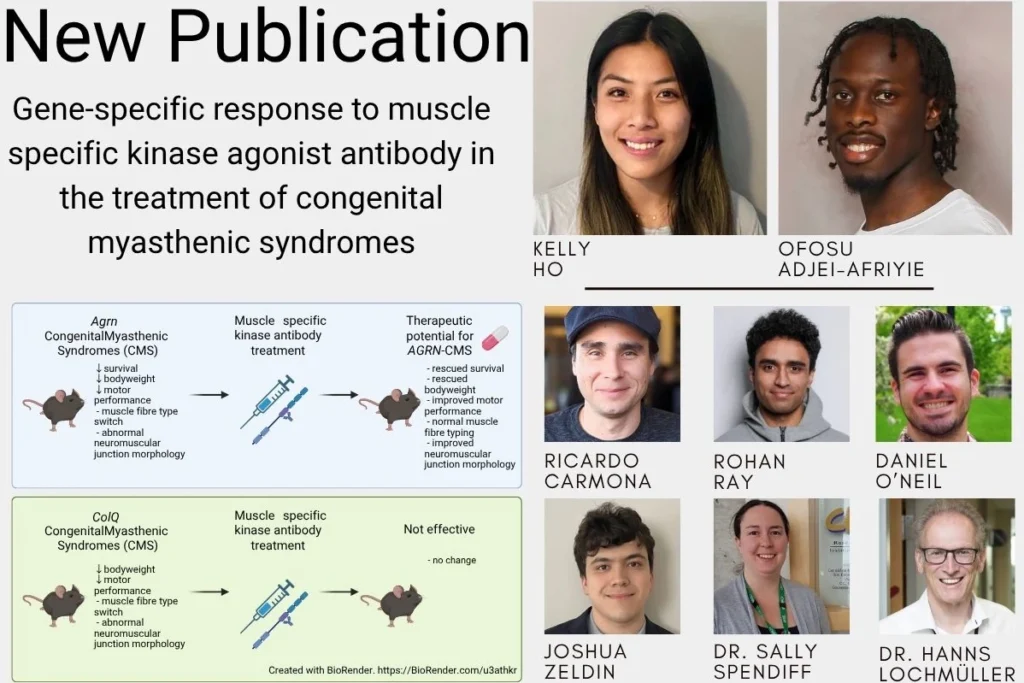
A new study from Hanns Lochmüller, PhD student Kelly Ho and recent MSc graduate Ofosu Adjei-Afriyie, in collaboration with the biopharmaceutical company argenx, explored whether a new therapy, a MuSK agonist antibody designed to strengthen signalling at the neuromuscular junction, could help treat two different forms of CMS in mice: AGRN-CMS and COLQ-CMS.
While both conditions can cause similar symptoms, they disrupt the neuromuscular junction in different ways. AGRN-CMS directly weakens an important muscle signalling pathway, while COLQ-CMS affects how nerve signals are cleared after muscles are activated.
Researchers found that the MuSK agonist therapy improved survival, muscle strength, body weight, and neuromuscular junction structure in mice with AGRN-CMS, but not in mice with COLQ-CMS. This study shows MuSK agonist as a promising potential therapy and highlights the success of Hanns Lochmüller’s bench-to-bedside approach. These results help to expand future CMS clinical trials to include kids and families with AGRN-CMS.
More broadly, the study highlights the important role of precision medicine in rare disease care. Even when two conditions look nearly identical clinically, understanding the exact genetic cause helps identify which treatments are most likely to work — offering hope for kids and families.
Reference
Ho K, Adjei-Afriyie O, Carmona-Martinez R, Ray R, O’Neil D, Zeldin J, Oury J, De Clercq L, Burden SJ, Vankerckhoven B, Vanhauwaert R, Spendiff S, Lochmüller H. Gene-specific response to muscle specific kinase agonist antibody in the treatment of congenital myasthenic syndromes. Brain Commun. 2026 May 14;8(3):fcag115. doi: 10.1093/braincomms/fcag115.
Click here to access the manuscript.
Read next...

Graham Mainwood Lecture – Dr. Markus A. Rüegg

PhD completion – Congratulations!
New Publications Alert!