New Publications Alert!
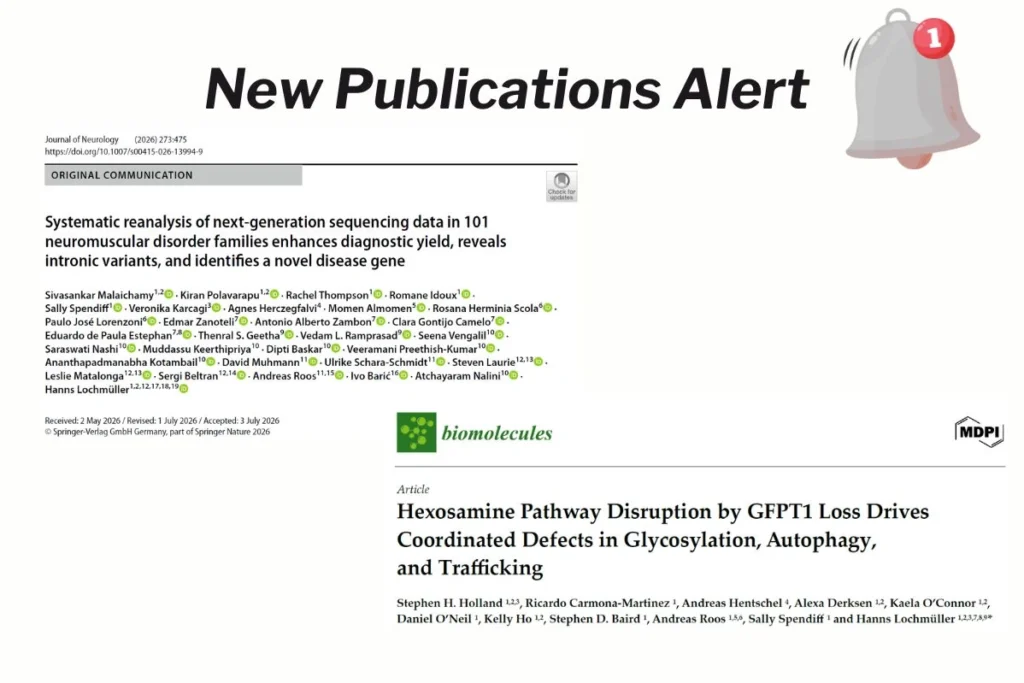
Our group has recently published two new papers with the first providing insights on the impact of GFPT1 loss in cellular models and the second highlighting importance of reanalysis in providing long awaited diagnoses to families with unsolved NMDs.
Publication 1: Hexosamine Pathway Disruption by GFPT1 Loss Drives Coordinated Defects in Glycosylation, Autophagy, and Trafficking
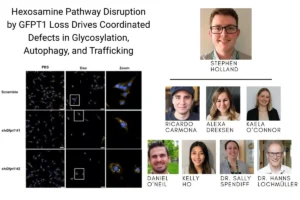
Stephen and co-authors investigated how the loss of GFPT1—the gene encoding glutamine-fructose-6-phosphate amido transferase 1, the rate-limiting enzyme of the hexosamine biosynthesis pathway—affects fundamental cellular processes. The work builds on previous discoveries linking GFPT1 mutations to congenital myasthenic syndromes and other disorders associated with defective protein glycosylation.
The researchers aimed to understand how disruption of the hexosamine biosynthesis pathway leads to cellular dysfunction. While GFPT1 deficiency is known to reduce the production of sugar metabolites required for protein glycosylation, it remained unclear how this metabolic defect gives rise to the broad range of cellular abnormalities observed in patients. The study sought to identify the molecular connections between impaired glycosylation, intracellular trafficking, and autophagy, and to determine whether these processes are coordinated through a common metabolic pathway.
To address these questions, the team generated cellular models lacking GFPT1 and used a combination of molecular, biochemical, imaging, and proteomic approaches to examine the consequences of enzyme loss. They analyzed changes in protein glycosylation, monitored intracellular trafficking pathways, assessed autophagic activity, and characterized alterations in cellular protein networks. By integrating multiple experimental techniques, the researchers were able to map how defects originating in the hexosamine pathway propagate through interconnected cellular systems.
The study found that loss of GFPT1 produces coordinated defects rather than isolated abnormalities. Reduced hexosamine pathway activity impaired protein glycosylation, disrupted intracellular trafficking, and compromised autophagy, revealing that these essential processes are functionally linked. The findings establish the hexosamine biosynthesis pathway as a central regulator of cellular homeostasis and provide new mechanistic insight into how GFPT1 mutations cause disease. By uncovering these interconnected pathways, the research also highlights potential therapeutic opportunities aimed at restoring glycosylation and metabolic balance in disorders associated with GFPT1 deficiency.
Reference
Holland SH, Carmona-Martinez R, O’Neil D, Ho K, O’Connor K, Azuma Y, Roos A, Spendiff S, Lochmüller H. Galactose treatment rescues neuromuscular junction transmission in glutamine-fructose-6-phosphate transaminase 1 (Gfpt1) deficient mice. Hum Mol Genet. 2025 Oct 14;34(21):1765-1779. doi: 10.1093/hmg/ddaf140.
Click here to access the manuscript
Publication 2: Systematic reanalysis of next‑generation sequencing data in 101 neuromuscular disorder families enhances diagnostic yield, reveals intronic variants, and identifies a novel disease gene
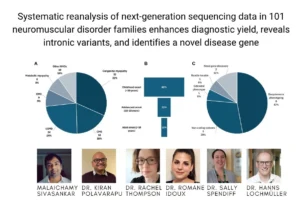
Malaichamy et al. have shown that taking a second look at previously inconclusive genetic sequencing data can significantly improve the diagnosis of inherited neuromuscular disorders. In a study of 101 families whose initial next-generation sequencing tests failed to identify a genetic cause, systematic reanalysis yielded new diagnoses in approximately one in five cases.
Rather than generating new sequencing data, the team re-examined existing datasets using RD-Connect Genome-Phenome Analysis Platform, expanded genetic databases, and current knowledge of gene–disease relationships. This approach uncovered disease-causing variants that had been missed during the original analysis, including several deep intronic mutations that disrupt RNA splicing but lie outside the protein-coding regions typically prioritized in genetic testing.
The reanalysis also led to the identification of ATP2A2 as a novel candidate gene associated with inherited neuromuscular disease. Previously recognized for its role in the skin disorder Darier disease, the gene was implicated in two unrelated families with recurrent rhabdomyolysis, expanding its known clinical spectrum.
The findings underscore the value of periodically revisiting genomic data as scientific knowledge advances. As new disease genes are discovered, variant interpretation improves, and analytical methods become more sophisticated, previously unsolved cases can receive long-awaited diagnoses. Overall, the study suggests that routine reanalysis of existing sequencing data should become an integral part of the diagnostic pathway for rare neuromuscular disorders, offering benefits for patient care, genetic counseling, and access to emerging precision therapies.
Reference
Malaichamy, S., Polavarapu, K., Thompson, R. et al. Systematic reanalysis of next-generation sequencing data in 101 neuromuscular disorder families enhances diagnostic yield, reveals intronic variants, and identifies a novel disease gene. J Neurol 273, 475 (2026). https://doi.org/10.1007/s00415-026-13994-9
Click here to access the manuscript
Read next...
Congratulations Dr. Alexa Derksen!

Graham Mainwood Lecture – Dr. Markus A. Rüegg

PhD completion – Congratulations!

Meet The Lochmüller group’s Newest Members!