
New publication: Periostin as a blood biomarker of muscle cell fibrosis, cardiomyopathy and disease severity in myotonic dystrophy type 1
Lochmüller Lab members published as authors in Journal of Neurology study
Myotonic dystrophy is the most common adult-onset muscular dystrophy and affects cardiac and endocrine systems and the central nervous system as well as the muscle. Our new paper in collaboration with colleagues in Germany looks into the question of biomarkers for this multisystemic disorder. “Periostin as a blood biomarker of muscle cell fibrosis, cardiomyopathy and disease severity in myotonic dystrophy type 1” is now available online ahead of print in the Journal of Neurology. Dr. Hanns Lochmüller and Dr. Sally Spendiff along with associated scientists Dr. Cynthia Gagnon and Dr. Andreas Roos, are all authors on the paper.
This collaborative international study identifies periostin, as a novel biomarker candidate for Myotonic dystrophy type 1 (DM1) and suggests that it may serve as a novel stratification biomarker for DM1 with clinical and pathophysiological relevance, correlating with disease severity, presence of cardiac malfunction, and fibrosis1.
The identification of periostin as a promising blood biomarker candidate in DM1 is especially impactful as there currently exists a lack of established biomarkers for DM1 in clinical practice. The study found that one distinct advantage of examining serum periostin is its ability to differentiate between DM1 patients with and without profound cardiac symptoms, with the potential to lead to the early identification of patients at high risk of cardiac pathology, a common cause of mortality in DM1.
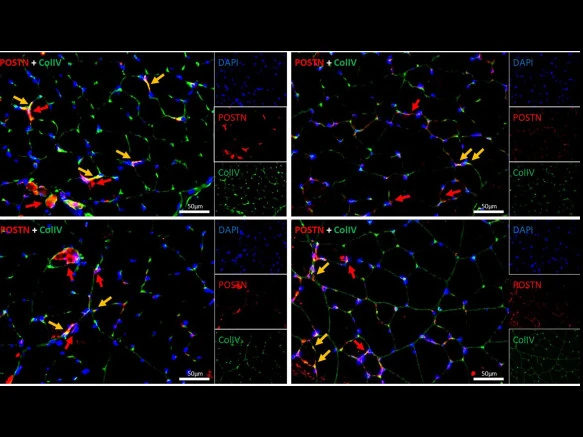
The study’s methodology included: immunostaining on skeletal and cardiac muscles from DM1 patients and DMSXL mice, which showed an extracellular increase of periostin indicating fibrosis; qPCR studies, which indicated increased periostin depositions (POSTN) expression in fibroblasts and muscle; quantification of periostin in blood samples from DMSXL mice and two large validation cohorts of DM1 patients, that showed decreased levels in animals and diseased individuals correlating with repeat expansion and disease severity and presence of cardiac symptoms identified by MRI. Periostin is not specific for DM1, it has also been described in other conditions where fibrosis is observed.
How to Find the Publication
This paper is not open access; If you do not have access through your institution, please contact Dr. Hanns Lochmüller to obtain a full-text version.
Reference
1. Nguyen, C. D. L., Jimenez-Moreno, A. C., Merker, M., Bowers, C. J., Nikolenko, N., Hentschel, A., Müntefering, T., Isham, A., Ruck, T., Vorgerd, M., Dobelmann, V., Gourdon, G., Schara-Schmidt, U., Gangfuss, A., Schröder, C., Sickmann, A., Gross, C., Gorman, G., Stenzel, W., Kollipara, L., … Roos, A. (2023). Periostin as a blood biomarker of muscle cell fibrosis, cardiomyopathy and disease severity in myotonic dystrophy type 1. Journal of neurology, 10.1007/s00415-023-11633-1. Advance online publication. https://doi.org/10.1007/s00415-023-11633-1. PMID: 36892629.
Read next...
New Publications Alert!

Meet The Lochmüller group’s Newest Members!

New Publication: Gene-specific response to muscle specific kinase agonist antibody in the treatment of congenital myasthenic syndromes