Two Research Lab Members Receive CIHR Funding Awards!
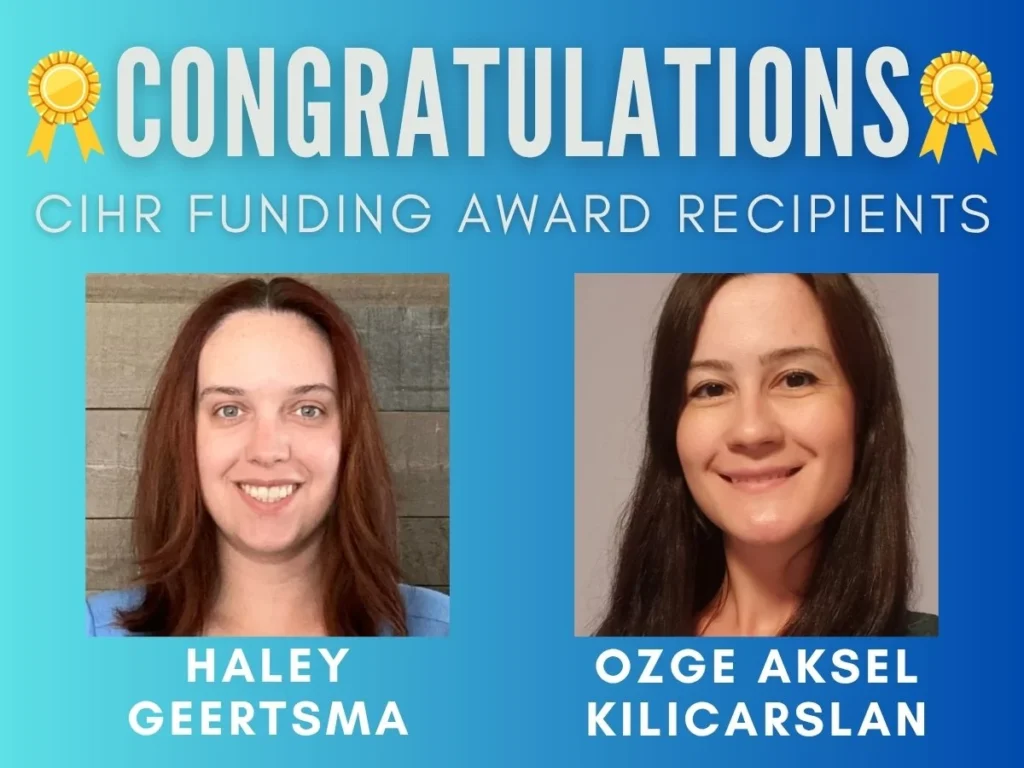
We are excited to share that two of our research team members have received competitive funding awards from the Canadian Institutes of Health Research (CIHR) to support their projects.
Academic awards for individual trainees not only provide vital funding for our lab members to pursue their research projects but also act as important recognition of their academic success that helps them to launch their future scientific careers. We are proud of our talented team members and delighted to share details of the successful awards here.
Dr. Haley Geertsma awarded Canada postdoctoral research award
Postdoctoral fellow Dr. Haley Geertsma was awarded a two-year postdoctoral fellowship from CIHR. This award provides $70 000 per year for a 2-year term to support Haley’s project: Using iPSC-derived neurons to identify novel biomarkers and drug candidates for myotonic dystrophy type 1. Although we know the underlying cause of Myotonic Dystrophy type 1, there remain no disease-modifying therapeutic options. Dr. Geertsma will use induced pluripotent stem cells donated from people with Myotonic Dystrophy to generate neurons. These neurons will be used to understand the biology of Myotonic Dystrophy to discover brain-specific markers of disease and therapeutic targets. Together, this work will bridge the gap in our understanding of Myotonic Dystrophy through the study of human cells, enabling a faster translation of our results into clinical trial to directly impact those affected by Myotonic Dystrophy.
Ozge Aksel Kilicarslan awarded Canada graduate scholarship doctoral award
PhD student Ozge Aksel Kilicarslan was awarded a three-year Canada Graduate Scholarship Doctoral Award (CGS-D) from CIHR. This award provides $40,000 per year for a 3-year term to support Ozge’s PhD project, which aims to improve genetic diagnosis for children with neuromuscular disorders through the application of artificial intelligence, computational genomics, and functional validation studies. Her research will analyze genome data from 500 patients with unsolved NMDs to identify disease-causing genetic variants, discover new disease genes, and uncover novel mechanisms of disease using computational approaches, cell and animal models, and international collaboration.
Read next...
Graham Mainwood Lecture – Dr. Markus A. Rüegg

PhD completion – Congratulations!
New Publications Alert!
Meet The Lochmüller group’s Newest Members!