Congratulations to the Lab’s Recent Graduates!
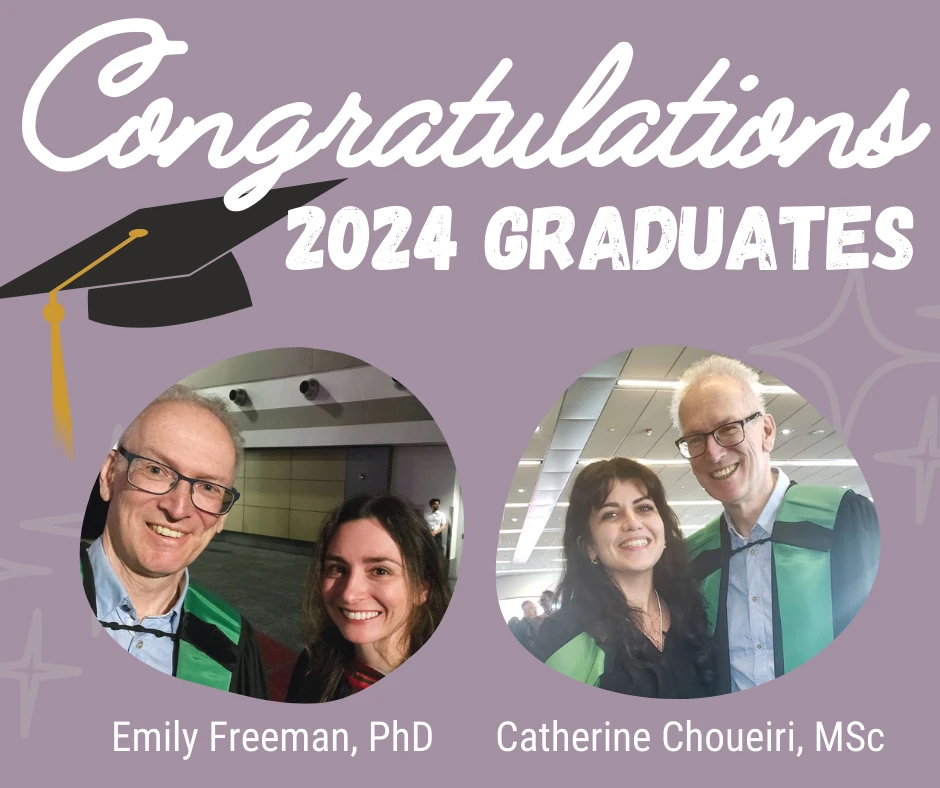
The Lochmüller Lab would like to congratulate two of our members on graduating from PhD and MSc programs at the University of Ottawa this past June.
Dr. Emily Freeman completed a PhD in Cellular and Molecular medicine with the Cowan lab at CHEO RI before joining us as a postdoctoral researcher and Catherine Choueiri completed an MSc studying Riboflavin Transporter Deficiency (RTD) with the Lochmüller Lab. Both graduates were honored at the University of Ottawa graduation ceremony on June 27, 2024 in Ottawa. Congratulations to both researchers on their graduations!
Dr. Emily Freeman receives PhD in Cellular and Molecular Medicine
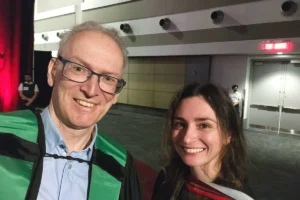
Hanns and Emily at uOttawa graduation ceremony 2024.
Dr. Freeman’s PhD thesis looked at the role of the small molecule channel Pannexin 1 in muscle regeneration and in Duchenne muscular dystrophy (DMD). Her study found that Pannexin 1 was crucial for the maintenance of size and strength of male but not female skeletal muscle. Furthermore, she discovered that Pannexin 1 function in reduced in dystrophic patient cells and its loss exasperated dystrophic symptoms in mice. This evidence lends strong support that restoring Pannexin 1 function could be a novel therapeutic approach for DMD. Emily will continue to work with the Lochmüller Lab as a postdoctoral research fellow.
Catherine Choueiri Receives MSc
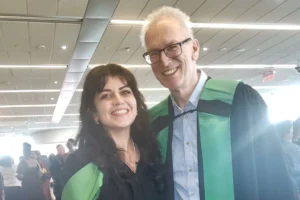
Hanns and Catherine at uOttawa graduation ceremony 2024.
Catherine’s MSc project focused on the development of zebrafish models of RTD for the purposes of therapeutic screening. She developed the first viable in vivo vertebrate model of RTD via constitutive knockdown of disease gene ortholog slc52a3. This model recapitulates key aspects of the disease phenotype including reduced motor functioning, motor axon shortening, and hearing impairment. This model was then employed for therapeutic screening of riboflavin and probenecid, a potential inhibitor of riboflavin excretion via inhibition of organic anion transporter 3. This model is specific and representative of human RTD, meaning it can also be employed in future drug screening efforts to uncover novel therapeutic strategies for this severe disease.
Read next...
Graham Mainwood Lecture – Dr. Markus A. Rüegg
PhD completion – Congratulations!
New Publications Alert!
Meet The Lochmüller group’s Newest Members!