New Publication: Partial loss of desmin expression due to a leaky splice site variant in the human DES gene is associated with neuromuscular transmission defects
Desmopathies are predominantly autosomal dominant neuromuscular conditions causing adult onset myofibrillar myopathy or cardiomyopathy due to heterozygous DES (DESMIN; OMIM: 125660) mutations. Recessive desminopathies caused by biallelic DES mutations are very rare and often present as more severely progressive myopathies with variable onset. With enriched expression in the postsynaptic membrane of the neuromuscular junction (NMJ), desmin plays a crucial role in structural and functional maintenance of the NMJ. However, except for a single literature report of a family with severe recessive desminopathy due to complete loss of desmin presenting as congenital myasthenic syndrome (CMS), DES mutations have not been reported as a cause of CMS.
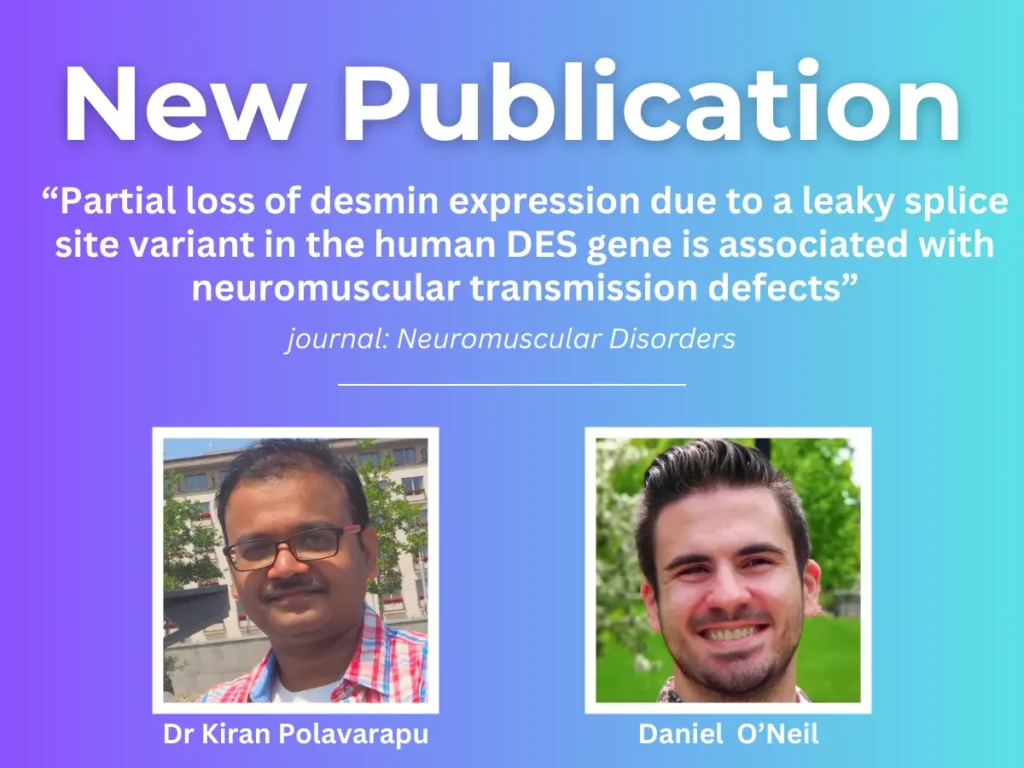
In a new study, “Partial loss of desmin expression due to a leaky splice site variant in the human DES gene is associated with neuromuscular transmission defects” published recently in the journal Neuromuscular Disorders, we identified a recurrent homozygous intronic variant in DES as causative in three previously unsolved limb-girdle CMS (LG-CMS) patients from India. This collaborative study between the Lochmuller Lab and the NIMHANS Neuromuscular team in Bangalore is authored by our postdoctoral researcher and CIHR fellowship recipient Dr. Kiran Polavarapu along with Daniel O’Neil as co-author and Dr. Hanns Lochmuller and Dr. Atchayaram Nalini as senior authors.
Dr. Kiran Polavarapu used the RD-Connect Genome-Phenome Analysis Platform (GPAP) to re-analyse exomes and genomes of unsolved CMS patients and identified the recurrent intronic mutation (c.1023+5G>A) in three unrelated Indian patients all of whom showed a similar LG-CMS phenotype. Reverse pheno-pathotyping conducted at NIMHANS showed partial loss of desmin and a myofibrillar myopathy pattern associated with desminopathy. Patients also partially benefitted from CMS treatment (salbutamol and pyridostigmine). Research Technician Daniel O’Neil under the guidance of Research Associate Dr. Sally Spendiff conducted RT-PCR and western blot experiments in muscle tissue of one of the patients to reveal the unique splicing defect caused by c.1023+5G>A resulting in only a partially correct splicing site and partial desmin loss correlating with pathology and milder phenotype observed in the patients.
This study not only established DES as an important CMS-causing gene with recessive inheritance but also identified a likely founder intronic mutation which leads to translational application in diagnosis and early treatment of similar LG-CMS patients especially in the Indian subcontinent.
Reference:
Polavarapu, K., O’Neil, D., Thompson, R., Spendiff, S., Nandeesh, B., Vengalil, S., Huddar, A., Baskar, D., Arunachal, G., Kotambail, A., Bhatia, S., Tumulu, S. K., Matalonga, L., Töpf, A., Laurie, S., Zeldin, J., Nashi, S., Unnikrishnan, G., Nalini, A., & Lochmüller, H. (2024). Partial loss of desmin expression due to a leaky splice site variant in the human DES gene is associated with neuromuscular transmission defects. Neuromuscular disorders : NMD, 39, 10–18. Advance online publication. https://doi.org/10.1016/j.nmd.2024.03.011
Read next...

Graham Mainwood Lecture – Dr. Markus A. Rüegg

PhD completion – Congratulations!
New Publications Alert!
Meet The Lochmüller group’s Newest Members!